



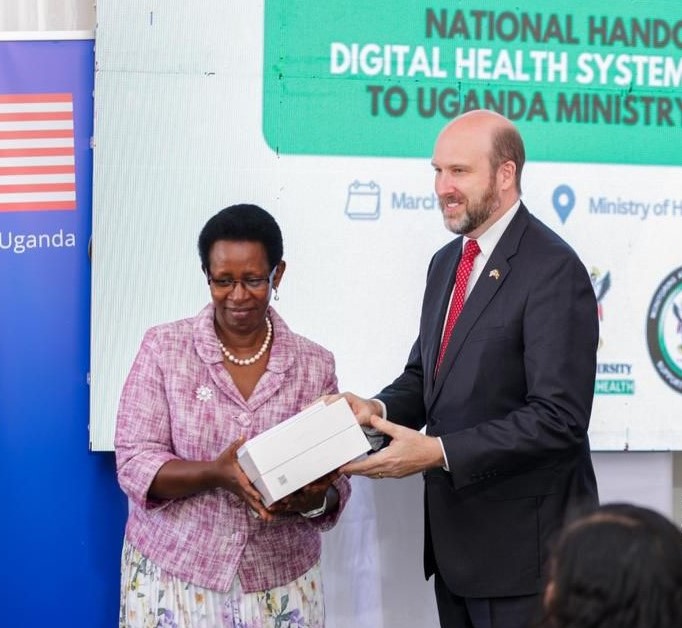
Uganda has officially assumed national ownership of 16 digital health platforms, marking a pivotal step in modernizing its health systems and strengthening the country’s public health resilience.
The handover ceremony, held in Kampala, brought together senior Ministry of Health officials, development partners, and representatives from the U.S. government, highlighting a long-standing partnership in advancing Uganda’s healthcare infrastructure.
Ambassador William Popp of the United States described the handover as “a tremendous day for recognizing the national transition of these digital health platforms,” noting that the initiative reflects over 15 years of U.S.–Uganda collaboration under the Monitoring and Evaluation Technical Support (METS) program. The handover follows a landmark Memorandum of Understanding signed in December 2025, under which the U.S. government committed $2.3 billion over five years to strengthen Uganda’s health systems, support frontline health workers, and ensure accountable use of resources.
“This handover is not only physical; it marks a new phase in national ownership and self-reliance,” Ambassador Popp said. He highlighted that METS investments, totaling more than $100 million since 2010 through the U.S. Centers for Disease Control, have strengthened Uganda’s HIV response, modernized national health information systems, improved disease surveillance, and enhanced emergency response capacity, including during the COVID-19 pandemic.
Dr. Rhoda Wanyenze, Dean of Makerere University School of Public Health, described the transformation in Uganda’s health data systems as “remarkable.” She explained that the integration of laboratory, surveillance, and clinical data has replaced cumbersome paper-based records, particularly in chronic care services such as HIV treatment.
“Gone are the days of massive paper records. Today, 16 integrated digital systems provide accurate, real-time data for planning, forecasting, and decision-making,” she said, emphasizing that the platforms support data-driven health interventions at national and district levels.

Permanent Secretary Diana Atwiine highlighted the importance of proper maintenance and accountability, urging health workers to safeguard the equipment as Uganda transitions to fully digital systems.
“This is a springboard for efficient health services and accurate data collection, ensuring that we can implement programs effectively and plan budgets appropriately,” Atwiine said. She also called on regional hospitals and district facilities to verify and account for all equipment to maximize operational efficiency.
Director General of Health Services, Charles Olaro, noted that the integration of digital systems has improved Uganda’s capacity to detect health trends, track disease outbreaks, and respond swiftly to public health emergencies. “These platforms strengthen surveillance, infection prevention, and workforce management, which is critical not only for Uganda but for regional and global health security,” he said.
The handover highlights Uganda’s growing autonomy in health governance. With complete adoption of digital reporting, the country has eliminated reliance on paper-based systems funded externally, achieving a milestone in sustainability and efficiency. Investments in infrastructure—including laptops, servers, solar power, and technical training—ensure that the Ministry of Health can maintain these systems independently, enhancing the resilience of national health services.
Ambassador Popp emphasized the global significance of the initiative. “When Uganda can detect and respond to disease outbreaks, it reduces the risk of cross-border health threats, protecting not only Ugandans but also the region and the world,” he said.
As Uganda embarks on this next phase, the METS program and its partners—including Makerere University, Baylor College, JCRC, and IDI—remain committed to supporting capacity building and continued innovation.
The handover represents not an end, but the beginning of a sustained, Ugandan-led transformation in digital health.