



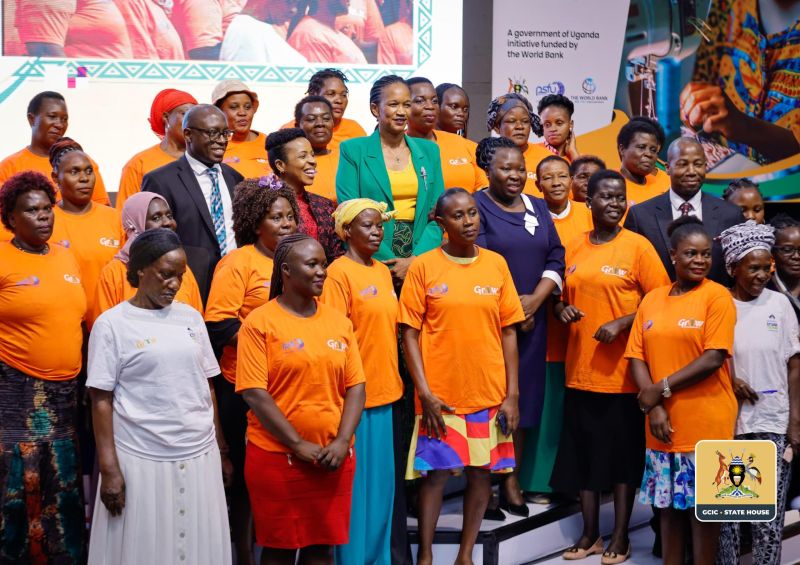
Uganda’s Generating Growth Opportunities and Productivity for Women Enterprises (GROW) Project is showing strong midterm progress, with thousands of women entrepreneurs already benefiting from training, skills development, and affordable financing aimed at boosting business growth and job creation across the country.
Speaking on the project’s achievements, Gender Specialist Prudence Atukwatse said the initiative, which started in 2023 and runs until December 2027, is already delivering measurable impact. “The project is already midway its implementation schedule. So far, we have achieved a lot,” she said.
One of the key milestones is in entrepreneurship training, where over 11,000 women have already been equipped with business management skills out of a target of 20,000. Atukwatse noted that the training is nationwide and inclusive. “These numbers are cutting across different parts of Uganda. We still have many women in the pipeline. Those who have not yet been trained can still apply through focal persons, the project secretariat, or directly via our website link,” she explained.
The project is also focusing on practical skills development through structured work placements. According to Atukwatse, more than 1,600 women have been oriented and matched to host institutions, while close to 1,000 are currently undergoing hands-on training in trades such as carpentry, welding, plumbing, computer literacy, painting, tailoring, catering, and hospitality.
“We have different partner institutions across the country. For example, Evergreen in central Uganda is supporting those in fashion and design, while Hotel Africana is hosting those in catering and hospitality,” she said, adding that the partnerships are expanding women’s exposure to real market environments.
On financing, Atukwatse highlighted that the GROW Loan facility has become a key driver of women-led enterprise growth. “As a ministry, we cannot lend directly, so we work with commercial banks and SACCOs,” she said.
Currently, six commercial banks—Centenary Bank, Finance Trust Bank, Equity Bank, DFCU Bank, PostBank, and Stanbic Bank—alongside several microfinance institutions and SACCOs including Pride Microfinance, Opportunity Bank, UGAFODE, and EBO SACCO are implementing the lending component.
By December last year, 4,889 women entrepreneurs had accessed loans under the program. “This is directly transforming women’s businesses across the country,” Atukwatse said.
She noted that loan conditions were revised after public feedback to improve accessibility. “Initially, the minimum loan was Shs4 million. But for refugees, we reduced it to Shs1 million, and for Ugandans to Shs2 million because we realized affordability challenges,” she explained.
The loans carry a maximum interest rate of 10 percent per year and operate as a revolving fund. “When one woman repays, another can access the same money. That is why this is one of the best-performing government loan programs for women entrepreneurs,” she added.
Early signs show positive impact. “We are seeing job creation, business expansion, and increased income. A woman who had a small shop can now stock more goods. Those in trade are expanding their inventory,” she said.
Atukwatse added that a comprehensive impact assessment is underway to measure long-term outcomes. “We want to understand how this financing is truly transforming women-owned businesses,” she noted.
The project has also developed a digital information management system to track and profile supported enterprises. “This is very important for national planning. We will know where women are, what they are doing, and the size of their businesses,” she said.
Implementation is coordinated through local governments with designated GROW focal persons across all districts, cities, municipalities, and refugee settlements. “This structure has improved coordination and partner engagement across Uganda,” Atukwatse said.
However, she acknowledged persistent cultural barriers affecting women’s economic empowerment. “We are seeing some progress, like families giving women land rights, which is very encouraging,” she said.
Still, she cautioned that decision-making remains a major challenge. “In many households, women still need permission to invest, sell, or even attend training. By the time they return to negotiate, opportunities are gone,” she explained.
Atukwatse called for mindset change among families. “We are urging husbands and male guardians to embrace joint decision-making and trust women. These are capable individuals who can run successful businesses,” she emphasized.
She encouraged communities to support rather than restrict women’s mobility and participation in training and markets. “Women should be allowed to travel, learn, and do business freely, and still return home and play their family roles,” she said.
For more information, Atukwatse advised women to contact district GROW focal persons or call the toll-free line 0800 30 7777 for guidance and support.