



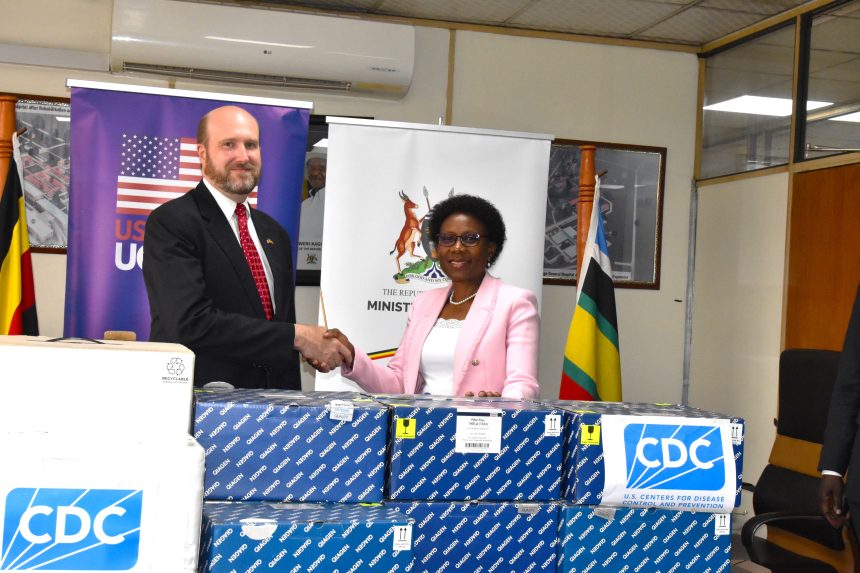
The U.S. government, through its public health agency, the U.S. Centers for Disease Control and Prevention (U.S. CDC), has donated 5,000 laboratory test kits and essential consumables valued at approximately $265,000 (around UGX 1 billion) to the Ministry of Health (MOH).
This contribution aims to bolster Uganda’s capacity to diagnose Mpox as the country faces a surge in cases. To date, Uganda has reported over 200 confirmed Mpox cases, including one fatality.
U.S. Ambassador William W. Popp formally handed over the donation to Uganda’s Health Minister, Dr. Jane Ruth Aceng, during a ceremony at the Ministry of Health headquarters.
The consignment, consisting of extraction kits and Polymerase Chain Reaction (PCR) primers and probes, will be distributed between Uganda’s primary testing facilities: the Uganda Virus Research Institute (UVRI) and Uganda National Health Laboratory Services (UNHLS).
This latest consignment brings the total number of test kits donated by the U.S. CDC since the Mpox outbreak began to 10,000.
Ambassador Popp highlighted the importance of empowering health personnel with necessary diagnostic tools for a complete and timely response.
“It is not enough to have skilled personnel; it is important to empower them with the tools to work—the test kits and consumables that we are handing over today are part of our deliberate effort to help ensure as complete, timely, and effective a response as possible,” he said.
This recent donation forms part of the broader U.S. government assistance of over $4 million (more than UGX 14 billion) provided since August, aimed at strengthening Uganda’s Mpox response through enhanced surveillance, risk communication, coordination, and contact tracing efforts.
For over 60 years, U.S. health and development assistance has supported Uganda’s efforts to improve public health infrastructure and response capabilities.
This long-standing partnership has played a crucial role in expanding Uganda’s internationally accredited laboratory capacity five-fold since 2015, enabling a stronger and more resilient health system to detect, prevent, and respond to health threats like Mpox.