



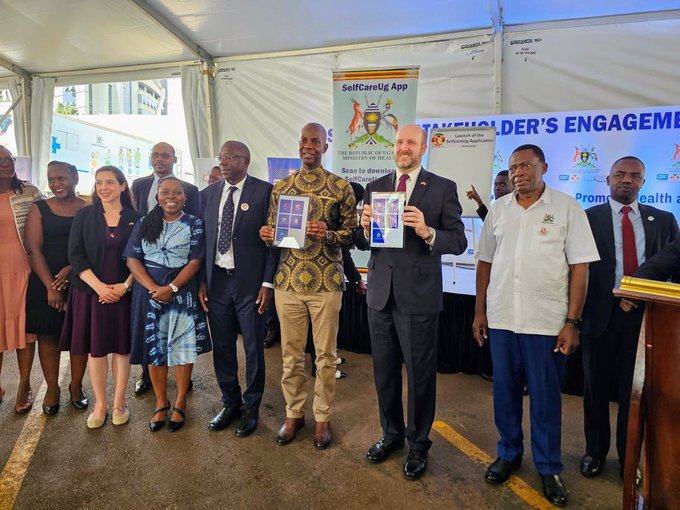
The Ministry of Health has launched a new digital self-care application aimed at empowering Ugandans with health information, access to services, and tools to improve personal well-being. The app, developed in partnership with the U.S. government and local stakeholders, was unveiled yesterday at the Ministry’s headquarters in Kampala.
Speaking at the launch, Dr. Charles Olaro, Director General of Health Services, emphasized that “health is wealth,” noting that personal well-being is the foundation of national and economic development. “Good health enables productivity, happiness, and the ability to pursue personal and financial goals. Investing in self-care is investing in the future,” he said.
The new app provides information and linkages across four key health areas: HIV, non-communicable diseases (including diabetes, hypertension, sickle cell, and mental health), maternal health, and family planning. Users can locate nearby facilities, compare costs of services such as HIV self-test kits, and access tailored educational resources through text, graphics, and video.
Dr. Paul Mbaka, Commissioner for ICT at the Ministry of Health, explained that the innovation evolved from earlier HIV self-testing initiatives. “We wanted something nationally owned and sustainable. The app now integrates multiple health modules on one platform to better serve Ugandans,” he said.
Prof. Frederick Makumbi from Makerere University School of Public Health welcomed the app as a tool for evidence-based public health programming. He also urged translation into local languages and adaptation for basic mobile phones to ensure inclusivity. “We don’t want this to create inequities, but rather close existing gaps,” he noted.
U.S. Ambassador to Uganda, William Popp, hailed the app as a milestone in Uganda’s digital health journey, building on decades of U.S.-Uganda health cooperation through PEPFAR and the CDC. “This innovation puts health directly in the hands of Ugandans. It strengthens resilience, reduces health system burdens, and ensures individuals have autonomy and privacy in managing their care,” he said.
Solomon Muhumuza, the Ministry’s app developer, demonstrated how the platform works, showing its ability to link users with nearby pharmacies, facilities, and service providers.
The self-care app is currently available for Android users, with an iOS version expected by the end of the month.
Officials say the innovation will not only improve access to health services but also lower healthcare costs, strengthen disease surveillance, and promote health literacy as a national priority.