



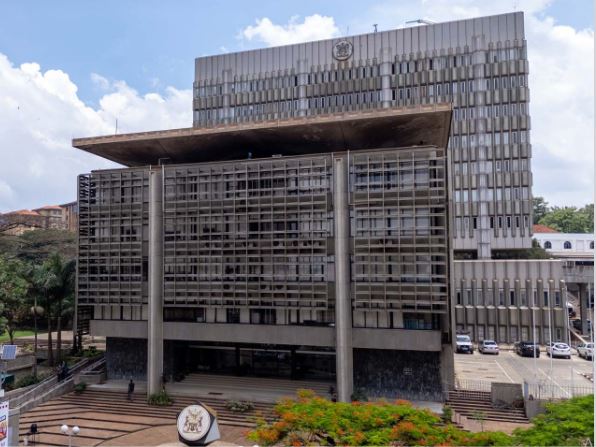
The Bank of Uganda (BoU) significantly increased its spending on staff and executive benefits during the financial year ending June 30, 2025, with new figures showing a sharp rise in employee costs and preferential loan facilities extended to senior management.
According to the BoU Integrated Annual Report for the year ended June 30, 2025, the central bank spent UGX 239.21 billion on staff salaries, wages, and allowances—an increase from UGX 192.26 billion in the previous year.
The report was presented to the Minister of Finance, Planning and Economic Development for onward submission to Parliament in accordance with Section 49(1) of the Bank of Uganda Act, which mandates the Bank to submit its annual report within three months after the close of each financial year.
The report reveals that total employee benefits surged to UGX 286.56 billion in 2025 from UGX 230.25 billion in 2024. The rise is attributed to adjustments in staff remuneration, higher social security contributions, and expanded welfare and capacity-building initiatives.
The Bank said the increase underscores its commitment to investing in human capital as a foundation for stronger institutional performance and service delivery.
A detailed breakdown of the staff expenditures shows that National Social Security Fund (NSSF) contributions and provisions rose to UGX 17.58 billion from UGX 14.00 billion in 2024, while defined contribution scheme pension payments increased to UGX 10.50 billion, up from UGX 7.89 billion the previous year.
The Bank also registered defined benefit plan gains of UGX 3.17 billion, a slight improvement from UGX 4.01 billion in 2024.
Meanwhile, spending on staff welfare, including medical expenses, climbed to UGX 16.79 billion, compared to UGX 15.11 billion a year earlier. Death-in-service insurance costs also rose from UGX 705 million to UGX 971 million, reflecting enhanced employee protection and benefits.
Similarly, the Bank’s expenditure on training and staff development projects increased modestly to UGX 4.68 billion, up from UGX 4.25 billion in 2024, indicating continued investment in upskilling and professional development.
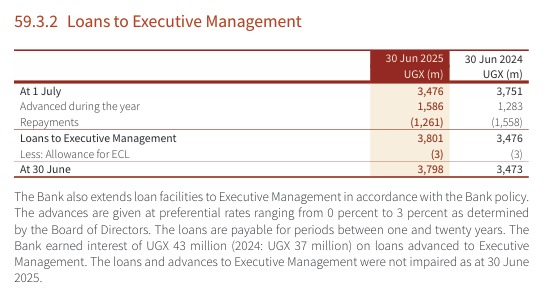
In addition to staff welfare, the central bank extended UGX 3.798 billion in loans to its top executive management during the same financial year. These loans were offered at preferential interest rates ranging between 0 and 3 percent, as determined by the Board of Directors.
The facilities are repayable over periods ranging from one to twenty years, in accordance with the Bank’s policy governing staff advances.
The report notes that BoU earned UGX 43 million in interest from these loans, up from UGX 37 million in 2024, signaling a steady but modest increase in the loan portfolio. The Bank said these advances are part of its employee retention and motivation framework designed to support senior management with affordable long-term financing.
Such low-interest loan schemes are common in public and financial institutions, intended to promote stability, retain top talent, and encourage commitment among key staff.
However, BoU’s decision to publicly disclose the details of the loans and related earnings has been lauded by governance experts as a positive step toward transparency and accountability in the management of public resources.
Beyond staff and executive benefits, the Bank of Uganda report reflects broader institutional priorities, including efforts to enhance operational efficiency, digital transformation, and policy innovation to sustain macroeconomic stability.
The central bank emphasized that maintaining a motivated and well-supported workforce remains essential to achieving its strategic objectives.
“The increase in employee-related expenditures demonstrates our continued investment in people, welfare, and institutional capacity,” the Bank noted in the report.
“These investments are crucial for strengthening performance and delivering on our mandate amid an evolving economic environment.”