



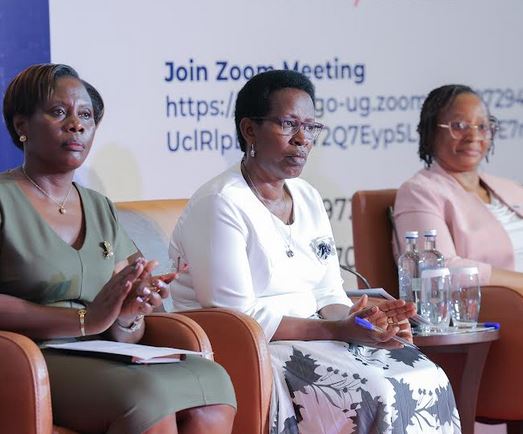
Senior Ministry of Health officials, development partners and health sector stakeholders convened this week for the 31st Annual Health Sector Joint Review Mission, where Dr. Diana Atwiine called for renewed commitment, deeper reflection and a transformative mindset to drive Uganda’s next phase of health sector progress.
Representing the Minister of Health, Dr. Atwiine delivered wide-ranging remarks emphasizing human resource excellence, efficiency, transparency, and readiness for the National Development Plan IV (NDP4).
She extended apologies for the meeting’s earlier postponements and conveyed the Minister’s greetings, noting that despite her absence, “she is with us in spirit.”
Dr. Atwiine led the meeting in a standing ovation for health workers across the country, praising their dedication in a challenging year. “We honour you. We value you. The milestones we celebrate today were made possible because of you,” she said.
She emphasized that Uganda’s greatest strength is not infrastructure or funding, but “an able workforce… the right people in the right places.” She encouraged leaders to reflect on their personal and institutional values, urging them to align these with national goals.
Reflecting on NDP3 performance, Dr. Atwiine acknowledged that not all targets were met, but said the sector is determined to deliver on NDP4. Achieving ambitious targets, she said, requires each stakeholder to recommit:
“Tomorrow (today 10th December) we launch a five-year strategic plan. I want each of you to look at it and commit to delivering your part. Every day you go to work, deliver your section of the plan.”
She urged partners and district leaders to anchor their contributions in excellence, quality and legacy.
Throughout her remarks, Dr. Atwiine repeatedly emphasized human resource as the foundation of a resilient and efficient health system.
“Resilience is human resource. Efficiency is human resource. Buildings and equipment alone cannot deliver,” she said.
She called for rethinking HR management—through improved mentorship, welfare, training, and mindset transformation—to ensure staff embody values such as patient-centeredness, respect, quality and selflessness.
Dr. Atwiine said the ministry expects all implementing partners to register on its accountability portal, disclosing funding levels, areas of operation and measurable results.
“We must see where money goes and the results attributable to it,” she stressed.
Digitization remains a top priority, particularly building data systems that generate timely and accurate information. Yet she cautioned that technology alone is insufficient: “Digitization comes back to human resource integrity.”
Amid volatile external financing, Dr. Atwiine said the ministry will intensify discussions on predictable and sustainable health financing. Reviving the long-delayed National Health Insurance Scheme remains a key goal, which she hopes Cabinet will reconsider after the election period.
Uganda is also negotiating a bilateral health financing agreement similar to those signed by Kenya and Rwanda, with details to be communicated once finalized.
Dr. Atwiine urged the health sector to use the two-day review not just to assess statistics but to reflect deeply on the next five years.
“What you are going to discuss should compel you to reflect, recommit and visualize the future of our sector,” she said.
She concluded by reminding leaders that legacy is created through people: “Legacy is not what we leave to people; it is what we leave in them.”