



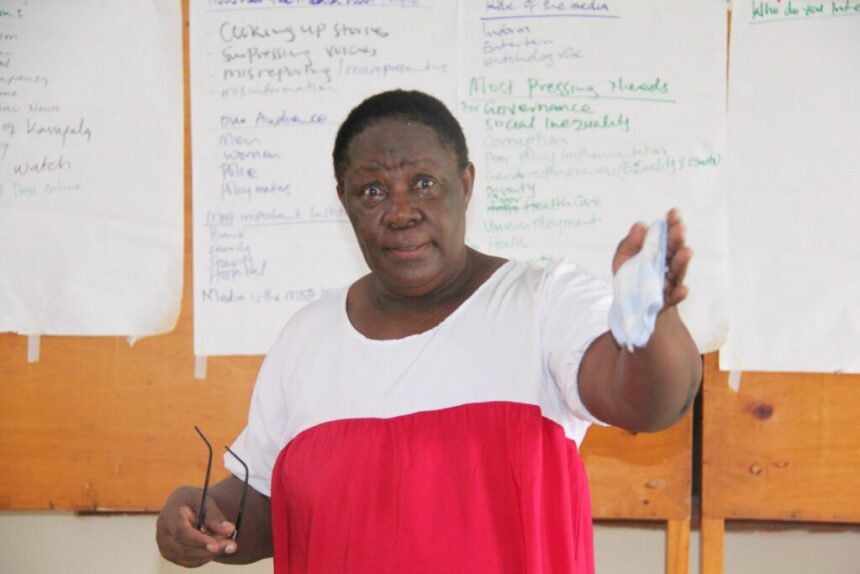
Margaret Sentamu has spent much of her professional life working to change how women are represented in Uganda’s media and how women participate within it.
As a staff member of the Uganda Media Women’s Association, she works alongside young people, experienced women, and supportive men who share a common goal: to make the media more inclusive, more balanced, and more reflective of society as a whole.
Two or three decades ago, Uganda’s media landscape was overwhelmingly male-dominated. Women’s voices were rarely heard, and the number of women working in newsrooms was strikingly low.
Many of those who did work in the media had entered the profession through informal routes, often without formal qualifications such as degrees or diplomas in journalism. Over time, that picture has begun to change, though not as much as advocates had hoped.
For more than 30 years, the Uganda Media Women’s Association has committed itself to promoting gender-responsive media. The organisation has trained men and women in gender-sensitive reporting, supported women journalists to become more assertive, and equipped women with skills to effectively use media platforms.
These efforts have contributed to gradual progress, but the imbalance remains stark. Women’s voices, Sentamu notes, are still significantly underrepresented in news coverage.
Uganda Media Women’s Association is part of the Global Media Monitoring Project, an international initiative coordinated by the World Association for Christian Communication and based in Canada.
Since 1995, the project has conducted regular surveys tracking gender representation and portrayal in media across the world. These studies have produced a body of evidence used by advocates, policymakers, and media practitioners seeking to address inequalities in media participation and content.
Uganda has been actively involved in this global monitoring since around 2015. The findings are consistent and troubling. In a typical sample of media content, out of 100 people quoted or featured in Ugandan media, only about 20 to 24 are women, compared to roughly 80 men.
This pattern persists despite years of training, research, advocacy, and even the establishment of women-focused media initiatives, including a gender-focused newspaper called The Other Voice and women-oriented broadcasting platforms.
The latest gender representation report produced by the association captured this imbalance with a stark title: half the population, quarter the media space. Women make up roughly 50 percent of Uganda’s population, yet receive only about 25 percent of quoted media space. For Sentam and her colleagues, this gap underscores the need for a more deliberate and systemic response.
Looking ahead, the organisation has developed a new vision under the banner half the population, half the media. This vision forms the core of its mission for 2026 to 2031 and beyond. Central to this plan is a nine-point programme designed to guide reforms that would make Uganda’s media genuinely gender-responsive.
The programme is grounded in research and is intended to be shared with political leaders and policymakers, particularly those who will form the next government.
One of the most urgent issues identified is the safety and security of women journalists. Sentamu points out that many media houses lack clear policies to protect female journalists. Surveys indicate that around three in ten women journalists have experienced sexual harassment, highlighting a serious gap in workplace protections and accountability.
Another concern lies in journalism education. Many training institutions still use curricula that are not gender-responsive, failing to equip future journalists with the skills and awareness needed to report fairly and inclusively. Sentamu argues that this is an area where government intervention and policy reform are essential.
Regulatory bodies also have a role to play. Institutions such as the Uganda Communications Commission and the Uganda Media Council, she says, should themselves become more gender-responsive.
This includes increasing women’s representation within these bodies, adopting gender-sensitive policies, and shifting their posture from enforcement-heavy “policing” to a more facilitative and supportive approach to media development.
Economic inequality within the media sector further compounds the problem. Government advertising, funded by taxpayers, tends to flow disproportionately to large, male-led media houses. Sentamu and her colleagues are calling for affirmative policies that would allow women-led, smaller, and community-based media organisations to access a fair share of public advertising revenue.
For Sentamu, the issue is not simply about numbers, but about democracy and representation. When women’s voices are marginalised in the media, public debate is narrowed and entire perspectives are lost.
Achieving gender balance in media, she argues, is essential not only for women, but for societies seeking fair, inclusive, and accountable public discourse.