



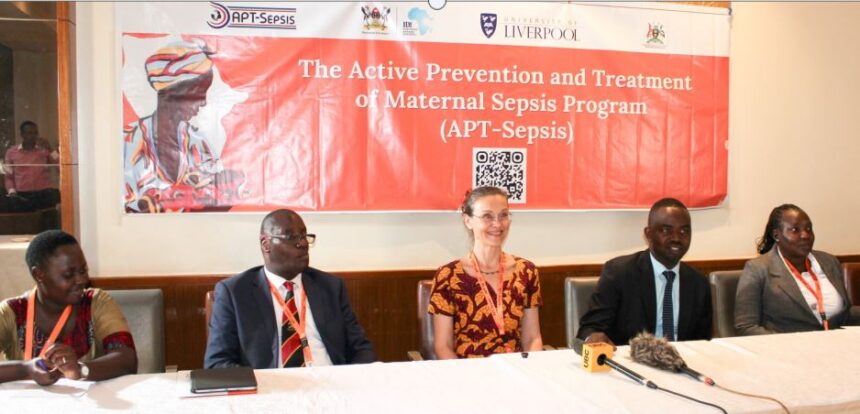
A major maternal health study under the APT-Sepsis Programme has delivered a breakthrough finding: simple, low-cost infection prevention measures can reduce deaths and severe illness among mothers by nearly a third.
Presenting the results, Catriona Waitt said the trial demonstrated that “very, very simple” interventions—when consistently applied—can have life-saving impact, without the need for expensive or complex medical technologies.
The cluster-randomised trial, conducted in partnership with Uganda’s Ministry of Health Uganda, covered 29 health facilities across Uganda, alongside 30 sites in Malawi. Facilities were split into two groups: one continuing standard care, and the other implementing a targeted package of infection prevention and management practices.
At the core of the intervention was a “bundle” of proven measures: strict hand hygiene, adherence to evidence-based clinical guidelines during childbirth and surgery, and early detection of infection using monitoring tools and treatment protocols such as the FAST-M approach.
“Hand washing is something we almost laugh about because it is so simple,” Waitt noted. “You don’t need fancy equipment—you just need to remember to do it and have access to water, soap, and sinks.”
The results were striking. The intervention group recorded a 32 percent reduction in deaths and severe illness linked to maternal infection—an outcome Waitt described as “an almost once-in-a-career result.”
Uganda has long battled high rates of maternal sepsis, previously estimated at 17 deaths per day. While overall maternal mortality has been declining, the study found that targeted infection control measures significantly accelerated progress.
Health workers were supported through mentorship, behavioural change strategies, and practical tools such as colour-coded monitoring charts to detect early warning signs like falling blood pressure or rising pulse rate. These tools also guided immediate clinical response, including administering fluids, antibiotics, and, where necessary, transferring patients.
Crucially, the study emphasised adaptability. Each facility identified and addressed its own barriers to infection control—from lack of running water to poorly placed hand sanitiser stations—ensuring solutions were locally relevant and sustainable.
Waitt stressed that the success was not about introducing new capacity, but strengthening what already existed. “The capacity was already there—the people, the teams. What we did was provide support, mentorship, and help create a culture where these practices are consistently followed,” she said.
All participating sites, including those initially in the control group, were trained in the intervention by the end of the study, ensuring wider uptake of the practices.
Experts say the findings could reshape how research translates into real-world care. Andrew Kambugu, Executive Director of the Infectious Diseases Institute, noted that the study bridges the long-standing gap between academia and frontline healthcare.
“What it means is that universities are often seen as isolated from the practicalities of life,” Kambugu said. “But this research identified an urgent, real-world challenge and produced high-quality evidence that the ministry—and even global actors like the WHO—can take up.” He added that the study’s replication in Malawi, with comparable results, underscores its scientific rigour and wider applicability.
For policymakers, the focus is now shifting to sustaining and expanding the gains. Richard Mugahi of the Ministry of Health Uganda said the country will intensify audits of maternal infections to track their origin and improve prevention.
“We are moving from a reactive system to a proactive one,” Mugahi said. “Sepsis prevention must be an active process—ensuring all inputs like sanitation are available at every point of care, and focusing on stopping infection before it starts.” He added that cases where mothers survive severe complications—known as “near-miss” events—will also be closely studied to prevent future fatalities.
At the frontline, health workers say the changes are already transforming care. Hannah Kemiyondo, a midwife at Mubende Regional Referral Hospital, said the programme has improved early detection and response to maternal infections.
“Before this programme, sepsis was a major concern because warning signs were often missed, leading to delayed treatment,” she said. “Through training and mentorship, we gained the skills to identify risks early and act quickly. Simple practices like hand hygiene and close monitoring have greatly improved outcomes for mothers.”
Kemiyondo added that tools like the FAST-M protocol—covering fluids, antibiotics, source control, transfer, and monitoring—have made it easier for midwives to respond effectively in busy maternity wards.
The study’s coordinator, Peace Okwaro, said the success was driven by hands-on training and strong leadership within health facilities.
“Frontline workers—midwives, nurses, doctors—were trained in practical approaches that could be integrated into everyday care,” she said. “But beyond training, leadership at facility level was critical. Where leadership was strong, we saw results quickly.”
Okwaro also highlighted the dedication of health workers who implemented the interventions despite heavy workloads. “Their commitment to improving infection prevention and management is what made the difference and delivered these results,” she said.
Despite the gains, experts caution that further work is needed, particularly at lower-level health centres and in communities where many women first seek care already infected. New efforts are underway to extend infection prevention awareness to village health teams and community settings.
Waitt also called for greater patient involvement, encouraging mothers to adopt hygiene practices and even hold health workers accountable. “Infection prevention is possible everywhere—before, during, and after delivery,” she said.
The findings of the study which was also done in Malawi, are expected to influence maternal health policy and scaling strategies across sub-Saharan Africa, offering a cost-effective pathway to saving thousands of lives.