



Uganda is shifting its public health strategy toward aggressive frontline communication, partnering with international agencies and civil society to train media analysts as the country battles a freshly confirmed Ebola outbreak.
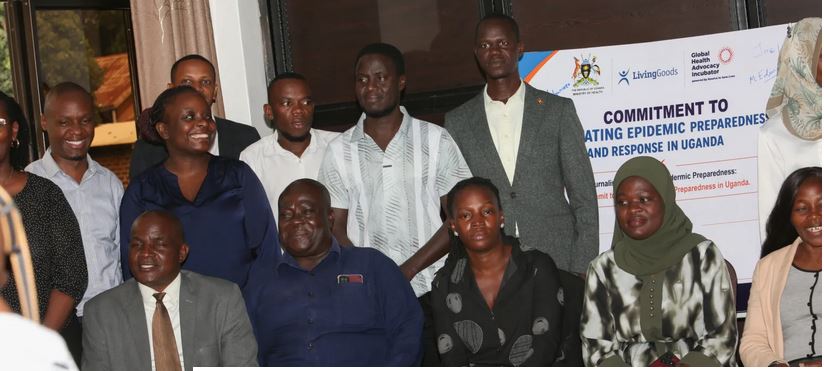
The initiative, launched by the Ministry of Health’s Division of Public Health Emergency Preparedness and Response in collaboration with the United Nations, was driven by a specialized training workshop recently hosted by Living Goods with support from the Global Health Advocacy Incubator.
The targeted training aims to build a wall of accurate information against a rising tide of digital misinformation during public health emergencies.
“So we felt as Living Goods it’s a very good idea to update the journalists in terms of the way they collect their stories or report information on epidemic preparedness”, said Richard Muhumuza Senior Manager, Projects and Service Delivery, Living Goods – Uganda .
With the current Ebola outbreak confirmed on May 15, 2026, officials are treating information dissemination as a core pillar of containment, equal in importance to laboratory testing and contact tracing.
Public health officials emphasize that journalists act as a critical early-warning system for the state’s medical infrastructure, creating a two-way data pipeline where reporters on the ground flag unusual community health spikes and the ministry uses those same media channels to push verified prevention protocols back to the public.
Media Coordinator for Health Journalists Network (HEJNU), Jael Namiganda,explained why it matters for journalists to report accurately on epidemics.
“For timely, accurate and understandable information, health reporters act as a bridge between scientists, government, health workers and the public and how this is reported influences whether people will seek treatment,accept vaccines, follow preventive measures or panic”,she noted.
Dr. Bonny Kintu of the Ministry of Health highlighted this symbiotic relationship, stating, “In our practice, in our day-to-day work, we get a lot of information from the communities, reporting unusual occurrences that might indicate emergence of diseases of outbreak concern within their communities. And some of this information we get from journalists, as they do their reporting of some of these incidents within their communities.”
“Social media has come up nowadays and they assume to be reporters,however most the information they give out is not reliable, in fact sometimes its myths and misinformation.So we as journalists have to come in and be the ethical part of that interaction”, added Namiganda.
Dr. Kintu further explained that the flow of data reverses once a threat is verified, noting, “But also, once we confirm some of these and put in place measures that we think will be able to protect the communities, again, we pass some of this information on to the journalists, again, to relay the feedback to the communities that are affected.
So, because of this, we think they’re very important stakeholders in our daily fight against some of these epidemics, majorly in the area of dissemination of information.”
Muhumuza emphasized that the training is not a reaction to poor reporting, but a necessity dictated by the fast-mutating nature of modern health crises, adding, “It’s not that they are not reporting well, but it’s just that information keeps evolving. And as information evolves, it’s also important to keep updating ourselves of this information.”
For Uganda, the stakes extend far beyond clinical metrics, as the country continues to navigate a complex health landscape while managing concurrent threats from measles, malaria, and severe fevers.
Beyond the immediate human toll, uncontained outbreaks present a severe macroeconomic threat to East Africa’s grid, as weak preparedness measures historically trigger a domino effect that causes sudden business closures, reduces labor productivity, depresses foreign exchange earnings from trade and tourism, and forces the diversion of thin national budgets toward emergency care facilities.
“There cannot have been a better time to invite journalists than now, when we are actually faced with a number of epidemic issues within the country. So we felt as Living Goods it’s a very good idea to update the journalists in terms of the way they collect their stories or report information on epidemic preparedness,” Muhumuza remarked.
As misinformation spreads rapidly across digital platforms during health emergencies, the Health Journalists Network is pivoting toward high-empathy, fact-based reporting.
Media strategies discussed at the convention urged reporters to focus heavily on survivor narratives to drive community compliance.
Muhumuza urged the journalists to leverage the power of personal recovery, saying, “Reach out to everyone who has survived the epidemic. There are very many stories about people who survived the epidemic, right? There is something they bring to the table that relates with others.”
Despite the current crisis, local health administrators point out that Uganda’s previous battles with infectious diseases, including coronavirus, have left the country with a resilient, decentralized surveillance framework where communities are highly responsive to early warning signs.
Dr. Asuman Basembeza, the District Health Officer for Mayuge District, explained that an established surveillance system is already active and prepared, noting, “Our community is very different because this is not the first epidemic. We have been having a number of epidemics, coronavirus, and I think this time when you alert them, they are responsive about the preventive measures of these epidemics.”
Dr. Basembeza detailed the structural readiness of the local health infrastructure, stating, “Already we have the system, like at the district, we have the reporting system, we have the surveillance right from the district to the HSD level, the sub-account up to the village level, we have the response team.”
He added, “We have the sample collection team that whenever there is a suspect with all those signs, the sample can be taken and taken to the national laboratory for verification, whether it’s a good case or it’s not a good case.”
As the containment effort continues, the integration of verified media reporting with this village-level medical surveillance will determine how quickly Uganda can neutralize both the economic and biological threats of the May 15 outbreak.
“We are very grateful as the Health Journalists Network to be invited by the Living Goods for this training in this time of epidemics. We believe that we are going to be well equipped as they promised to give us a lot of resources and people who will help us to report better,” Namiganda concluded.