



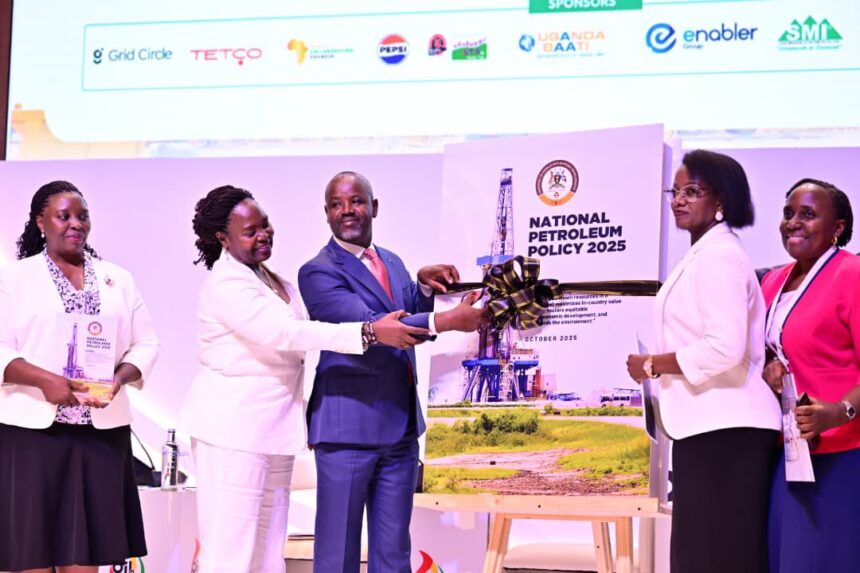
Uganda’s oil and gas story is entering a decisive new chapter—one that policymakers and investors alike say will define the country’s economic trajectory for decades.
At the 11th Oil and Gas Convention held at Speke Resort Munyonyo, senior government leaders laid out a vision that blends resource monetisation with long-term industrial transformation, while calling for discipline, speed and deeper local participation.
Speaking to an audience of industry executives and financiers, Energy Ministry Permanent Secretary Irene Batebe signaled a policy shift anchored in Uganda’s transition from exploration to sustained production. She noted that the outgoing 2008 National Oil and Gas Policy had “served the country very well,” enabling job creation for Ugandans and the rise of local service companies across the petroleum value chain.
But the next phase, she emphasized, is about scale and longevity. A new policy framework—expected to be launched soon—will focus on expanding reserves, improving recovery rates, and accelerating licensing to attract fresh capital.
“We are opening up licensing beyond purely competitive rounds to include direct applications, so we can bring resources on stream faster,” she said, in a move likely to appeal to agile upstream investors.
The policy also prioritizes value addition, with government positioning refining and petrochemicals as the backbone of future returns. From fertilizers to plastics, Uganda is targeting downstream industries that can anchor industrial parks and reduce import dependency. For investors, this signals a shift from short-term project cycles to integrated, long-horizon opportunities across upstream, midstream and downstream assets.
Energy Minister Ruth Nankabirwa reinforced this strategy, framing oil revenues as catalytic capital rather than an end in themselves. She acknowledged global energy transition pressures but stressed Uganda’s pragmatic approach: using hydrocarbons to finance infrastructure, expand electricity transmission, and invest in renewables.
“We are laying a foundation for 30 years of production that must deliver lasting value,” she said, urging private sector players to seize emerging opportunities. However, she also pointed to bottlenecks—particularly delays in industrial park development and early-stage infrastructure—that risk slowing investor uptake despite strong interest from at least 31 identified firms.
Nankabirwa highlighted growing coordination between government agencies and financial institutions to localize supply chains, from agriculture to logistics. Her message was clear: the oil economy must spill over into broader sectors, ensuring Ugandans capture value beyond core petroleum operations.
With focus is on governance and scale,deputy Speaker Thomas Tayebwa struck a firm tone, pledging parliamentary backing for the sector while demanding transparency and meaningful local participation.
“We don’t want local content for the sake of it—we want Ugandans accessing the big money,” he said, challenging both government and international oil companies to move beyond subcontracting into equity and high-value contracts.
Tayebwa also positioned Uganda within a regional energy ecosystem, advocating for accelerated refinery development and petrochemical production to serve East Africa’s growing demand. Rising input costs for manufacturers, he noted, underscore the urgency of domestic processing capacity.
Uganda is shifting from a capital-intensive construction phase into a production-driven economy expected to run for at least three decades. This transition opens the door to stable, long-term returns through operations, maintenance, and service contracts—areas where institutional investors and local firms alike can participate.
With major infrastructure underway and policy reforms aligning with global investment trends, Uganda is increasingly positioning itself as a regional energy and industrial hub.
The challenge now, as speakers repeatedly stressed, is execution—turning policy ambition into bankable projects and ensuring that the country’s النفط wealth translates into inclusive, sustained growth.